Table of Contents
ToggleWhite cabinets are everywhere in kitchens right now, and for good reason. They’re clean, classic, and they won’t fight with your countertops or flooring. But all that white can feel cold or sterile if the wall color isn’t pulling its weight. The right paint color behind white cabinetry can define your kitchen’s personality, whether that’s cozy farmhouse, sleek modern, or something in between. This guide walks through proven color palettes that work with white cabinets, from warm earthy tones to bold statement darks, plus practical tips on finish selection and testing before you commit a single gallon.
Key Takeaways
- White cabinets act as a neutral canvas that allows kitchen paint colors to define your space’s mood—whether cozy farmhouse, sleek modern, or anything in between—without competing for visual attention.
- Warm earthy tones like terracotta and soft peach, as well as timeless greige and taupe, create inviting kitchens with white cabinets and work best when undertones match your cabinet’s temperature.
- Cool blues and soft greens pair naturally with white cabinetry for a calm, refreshing kitchen, but require careful observation in north-facing spaces or rooms with limited natural light.
- Dark navy, charcoal, and black accent walls create striking contrast and architectural interest with white cabinets, but demand ample natural light, proper surface prep, and multiple paint coats for even coverage.
- Test kitchen paint color samples on poster board in multiple light conditions before committing, and use satin or eggshell finishes for durability and easy cleaning near cooking zones.
- Proper surface preparation—including degreasing, patching, sanding, and priming—ensures your kitchen paint colors adhere evenly and last longer than rushing straight to topcoats.
Why White Cabinets Are the Perfect Canvas for Bold Color Choices
White cabinets offer a neutral backdrop that doesn’t compete with wall color. Unlike wood-tone or colored cabinetry, white reflects light and allows the wall paint to set the mood without clashing. This makes them forgiving for experimentation, a bold navy or deep charcoal that might overwhelm a kitchen with dark cherry cabinets will feel balanced when framed by white.
From a design standpoint, white cabinetry acts like trim or baseboard: it defines edges and creates contrast. That contrast is what makes a paint color read clearly. A soft greige might disappear against beige cabinets, but against white, it gains definition and warmth.
White cabinets also adapt to evolving trends. If you tire of a color in three years, repainting walls is far cheaper and easier than replacing or refinishing cabinetry. That flexibility is a huge practical advantage for homeowners who like to refresh their spaces without major renovation costs.
Finally, white reflects ambient and task lighting better than darker cabinet finishes, which means your wall color gets more even illumination. This helps you see the true hue in different light conditions, critical when choosing between similar shades.
Warm and Inviting: Earthy Tones That Complement White Cabinetry
Warm paint colors bring coziness to a kitchen without sacrificing brightness. Terracotta, soft clay, and muted ochre tones pair beautifully with white cabinets, especially in kitchens with natural wood floors or butcher-block countertops. These colors work well in spaces that get morning or southern light, where the warmth intensifies without turning muddy.
Terracotta and clay tones (think SW Cavern Clay or Behr Tuscan Beige) add a sun-baked, Mediterranean feel. They’re trending in 2026 as homeowners move away from cool grays. These hues work best on accent walls or in kitchens with high ceilings, full-room application can feel heavy in a small galley kitchen.
Soft peach and apricot shades offer warmth with a lighter touch. They’re flattering in kitchens with white subway tile backsplashes and brass or gold fixtures. A color like Benjamin Moore Peach Parfait reads as a neutral in natural light but warms up beautifully under incandescent or LED bulbs with a warm color temperature (2700K–3000K).
When using earthy tones, keep undertones in mind. If your white cabinets lean cool (bright white or blue-white), choose warm paint colors with a touch of gray to avoid jarring contrast. If your cabinets are warmer (cream, off-white, or antique white), lean into richer, more saturated earth tones.
Greige and Taupe for Timeless Elegance
Greige, a blend of gray and beige, remains one of the most reliable choices with white cabinets. It’s neutral enough to work with stainless steel appliances, warm enough to avoid feeling sterile, and versatile across design styles from transitional to modern farmhouse.
Popular greiges like Sherwin-Williams Agreeable Gray, Benjamin Moore Revere Pewter, and Behr Moth Wing offer subtle warmth without reading as tan. These colors have a balanced undertone that shifts slightly depending on light exposure, which keeps them from feeling flat.
Taupe leans slightly browner and warmer than greige. It’s a strong pick for kitchens with wood elements, exposed beams, hardwood floors, or a wooden range hood. Taupe grounds the space and complements white cabinets without competing for attention. Consider Benjamin Moore Smokey Taupe or SW Loggia for a sophisticated, gallery-like feel.
Both greige and taupe are forgiving when it comes to design ideas for smaller kitchens, where too much contrast can make the room feel choppy. They also hide minor wall imperfections better than stark white or very dark colors.
Cool and Calm: Blue and Green Hues for a Refreshing Kitchen
Blue and green tones bring a sense of calm and cleanliness, ideal for a kitchen. They pair naturally with white cabinets and work especially well in homes with coastal, farmhouse, or Scandinavian design influences.
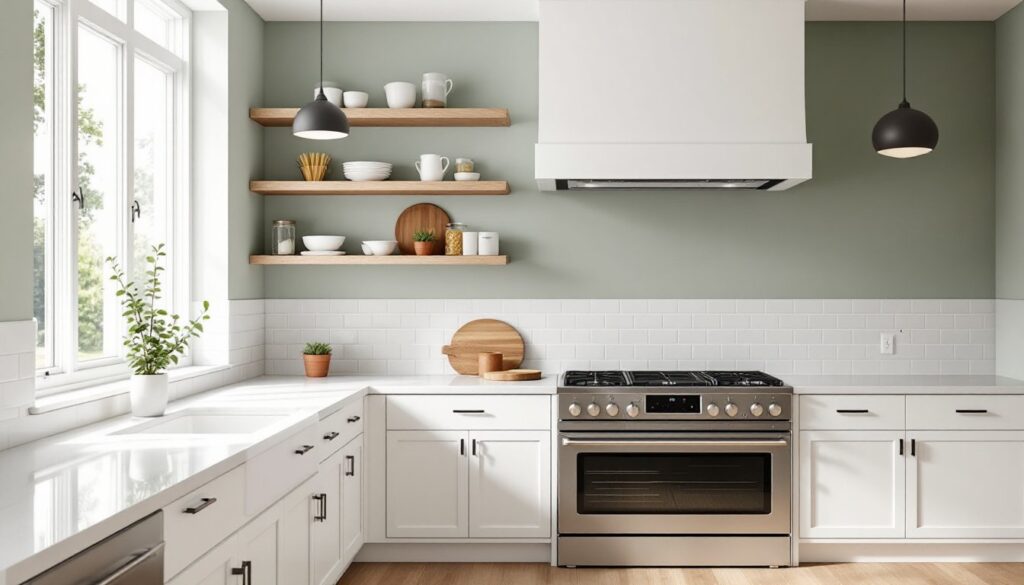
Soft sage and mint greens are having a moment. These colors feel fresh without being too bold. Farrow & Ball Pigeon or Benjamin Moore Saybrook Sage offer muted, earthy greens that ground a space while still feeling light. They’re excellent in kitchens with white marble or quartz countertops and natural fiber rugs.
Classic blues, from powder blue to deeper slate, are timeless with white cabinetry. A soft blue like SW Atmospheric or Benjamin Moore Palladian Blue works in kitchens with limited natural light, as it reflects and diffuses whatever light is available. These shades work well in older homes or cottage-style kitchens where a crisp, airy feel is the goal.
Darker teals and navy-adjacent greens (like SW Oceanside or BM Tarrytown Green) function as accent colors. Use them on a single wall behind open shelving or as a bold choice in a kitchen with great natural light and high ceilings. Pair with unlacquered brass or matte black hardware for contrast.
When choosing cool tones, pay attention to your lighting. North-facing kitchens can make blues and greens read colder than intended. Test samples in the actual space and observe them at different times of day. LED bulbs with a neutral white (3500K–4000K) color temperature help maintain true color without adding unwanted warmth or coolness.
Statement-Making Darks: Navy, Charcoal, and Black Accent Walls
Dark colors can feel risky in a kitchen, but when paired with white cabinets, they create high-impact contrast and architectural interest. This approach works best in kitchens with ample natural light, high ceilings, or a large footprint.
Navy is the most approachable dark option. Colors like SW Naval or Benjamin Moore Hale Navy offer depth without feeling oppressive. Navy reads as a rich neutral and pairs well with gold, brass, or copper accents. It’s particularly effective on a single accent wall, behind a range or on a wall opposite large windows, where it anchors the space without overwhelming it.
Charcoal and deep gray (like BM Kendall Charcoal or SW Peppercorn) provide a modern, industrial edge. These work well in contemporary kitchens with white shaker or flat-panel cabinets, concrete countertops, and matte black fixtures. The key is balance: if you’re going dark on walls, keep floors lighter (light oak, white oak, or pale tile) to maintain visual breathing room.
True black is bold but doable. It works in kitchens with significant white surfaces, think white cabinets, white countertops, and a white tile backsplash. Black walls (SW Tricorn Black or BM Onyx) create drama and make design upgrades to white cabinetry stand out even more. Use a matte or eggshell finish to avoid a stark, reflective surface.
Safety and prep note: Dark colors show surface flaws more than lighter tones. Before painting, fill nail holes, sand rough patches, and prime with a high-quality stain-blocking primer like Zinsser Cover Stain or Kilz 2. Dark paints also require more coats, budget for at least two, sometimes three, for even coverage. Wear a respirator mask if painting in a poorly ventilated space, especially with oil-based or low-VOC primers.
Soft Neutrals and Pastels for a Light, Airy Feel
If the goal is brightness and openness, soft neutrals and pastels keep the kitchen feeling spacious and serene. These colors work especially well in smaller kitchens, galley layouts, or spaces with limited natural light.
Barely-there grays and warm whites (like Benjamin Moore Classic Gray or SW Alabaster) offer subtle contrast with white cabinets without closing in the space. They’re ideal for open-concept homes where the kitchen flows into a living or dining area, the soft color transition keeps sightlines open.
Pale blush and dusty rose tones bring warmth with a feminine touch. Colors like BM Proposal or Farrow & Ball Setting Plaster feel modern and sophisticated, especially with white cabinets, marble countertops, and brass hardware. These work well in kitchens with abundant natural light and white or light wood floors.
Soft lavender and lilac are emerging as unexpected neutrals in 2026. They add personality without overwhelming, and they pair surprisingly well with white cabinetry and stainless appliances. Try BM Lavender Mist or SW Potentially Purple on an accent wall or in a butler’s pantry.
When working with pastels, use a satin or eggshell finish for easy cleaning. Kitchens see grease, steam, and spills, flat paint is harder to wipe down without leaving marks. Coverage is typically 350–400 square feet per gallon for quality paints like Benjamin Moore Regal Select or Sherwin-Williams Duration Home, but plan for two coats on previously darker walls.
How to Choose the Right Finish and Test Your Color Before Committing
Paint finish matters as much as color in a kitchen. The wrong sheen can make even a great color look off, and it affects durability and cleanability.
Finish options:
- Flat/Matte: Hides imperfections but hard to clean. Avoid in kitchens unless it’s a low-traffic accent wall far from the stove.
- Eggshell: Slight sheen, easier to wipe than flat. Works for most kitchen walls if you’re diligent about ventilation and don’t have major grease issues.
- Satin: The sweet spot for kitchens. Washable, durable, subtle sheen. Recommended for walls near cooking zones.
- Semi-gloss: Very durable and scrubbable. Best for trim, cabinets, or high-moisture areas. Can look too shiny on large wall expanses unless you want a vintage or high-gloss modern look.
Before committing to a full room, test your color properly. Buy sample pots (usually 8 oz.) and paint at least two 2′ × 2′ sections on different walls, one that gets direct light and one that doesn’t. Let the paint dry fully (24 hours) and observe it in morning, midday, and evening light. Colors shift dramatically depending on exposure.
If possible, paint samples on poster board or foam core and move them around the room. This is especially useful if you’re deciding between multiple shades. Some pros recommend painting samples next to your cabinets and backsplash to see the interaction up close.
Pro tip: Most paint failures come from poor surface prep. Wash walls with a degreaser like TSP substitute, rinse, and let dry. Fill holes with spackling compound, sand smooth with 120-grit sandpaper, and prime any patched areas or stains. For kitchens with cooking residue, use a stain-blocking primer on all surfaces before your topcoat.
Finally, always check if your municipality requires permits for any structural changes. While repainting doesn’t require a permit, if you’re combining it with electrical work (adding undercabinet lighting, moving outlets), you may need an inspection depending on local codes. When in doubt, consult your local building department or a licensed electrician.