Table of Contents
ToggleTiny houses pack a surprising amount of livability into footprints ranging from 100 to 400 square feet. The real challenge isn’t just building small, it’s designing interiors that work hard without feeling cramped. Inside a well-planned tiny house, every square inch has a purpose: stairways hide storage, furniture folds away, and vertical space does double or triple duty. Understanding how tiny house interiors function means looking beyond Pinterest boards to the actual joinery, clearances, and material choices that make small-space living practical.
Key Takeaways
- Inside tiny houses, every square inch must serve a purpose through innovative storage solutions like stair drawers, toe-kick cabinets, and built-in benches that maximize limited space.
- Ceiling height and headroom constraints in tiny house interiors require careful planning—most units offer 6’6″ to 7′ of standing clearance with sleeping lofts typically at 3′ to 4′ tall.
- Multi-functional furniture such as Murphy beds, expandable tables, and storage ottomans allows tiny house occupants to adapt their living space throughout the day.
- Material choices in tiny house construction prioritize weight reduction and insulation efficiency, favoring lightweight plywood, spray foam, and tongue-and-groove finishes over traditional drywall.
- Kitchen and bathroom layouts in tiny houses demand strategic planning, with kitchens typically offering 4′ to 8′ of counter space and bathrooms ranging from compact corner showers to innovative wet bath designs.
- Light color palettes, vertical design lines, and strategic mirror placement create the visual illusion of larger interiors while maintaining the minimalist aesthetics that work best in small-space living.
What Makes Tiny House Interiors Unique?
Tiny house interiors rely on precision carpentry and intentional layout planning. Unlike conventional homes where rooms serve single purposes, tiny houses eliminate hallways, combine spaces, and layer functions. A dining table might fold down from the wall, a couch might convert to a bed, and a staircase might double as a pantry.
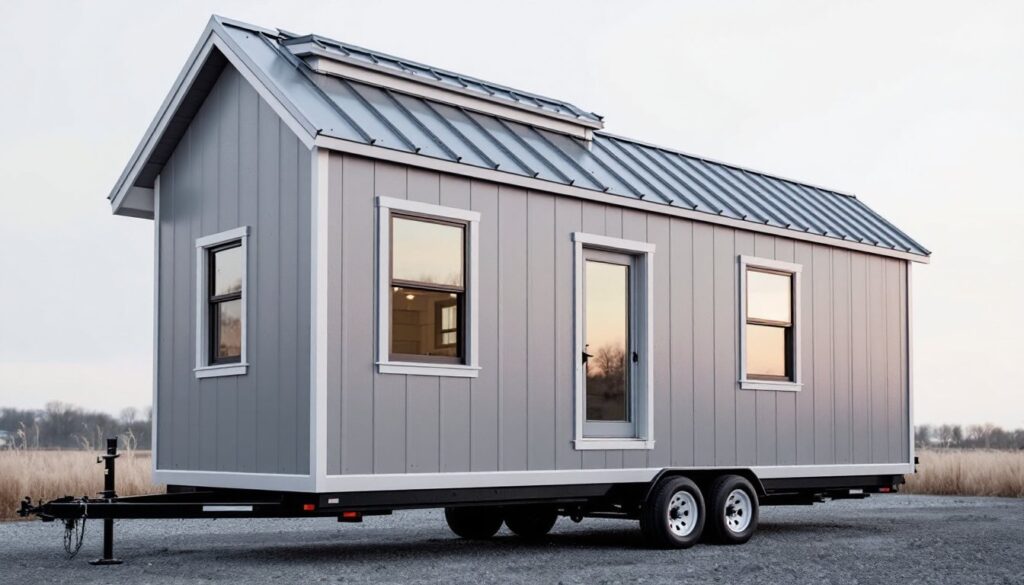
Ceiling height matters more in tiny houses than in traditional homes. Most tiny houses on wheels must stay under 13’6″ total height to remain road-legal without special permits, which leaves roughly 6’6″ to 7′ of interior headroom after accounting for trailer deck, floor framing, and roofing. That’s enough for most adults to stand comfortably, but loft spaces typically drop to 3′ to 4′ of clearance, fine for sleeping, tight for sitting upright.
Material choices also shift. Because weight affects towing capacity, builders favor tongue-and-groove pine or lightweight plywood for interior walls instead of drywall. Insulation is critical in such small volumes, spray foam or rigid foam panels are common because they add R-value without eating up precious inches. Decisions about modern architecture and sustainable design principles often influence material selection, especially in custom builds.
Natural light becomes essential when floor space is limited. Tiny houses often feature oversized windows, skylights, or glass doors to visually expand interiors. But, too much glazing can compromise privacy and thermal performance, so placement requires careful thought.
Clever Storage Solutions That Maximize Every Inch
Storage in tiny houses isn’t an afterthought, it’s embedded into the structure itself. Builders and owners get creative with dead space: under stairs, above doorways, beneath seating, and inside risers.
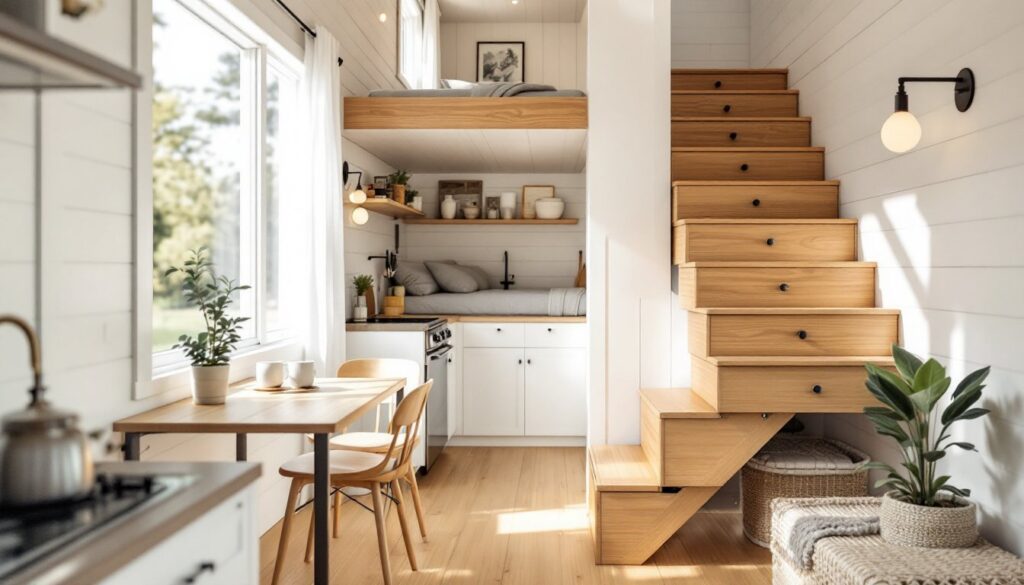
Stair storage is one of the most efficient tricks. Rather than using a simple ladder to reach a loft, many tiny houses install full staircases with drawers or cabinets built into each tread. Each step becomes a pull-out drawer roughly 10″ deep and 24″ to 30″ wide, enough for shoes, tools, or pantry items. This approach sacrifices some floor space compared to a ladder but improves safety and usability.
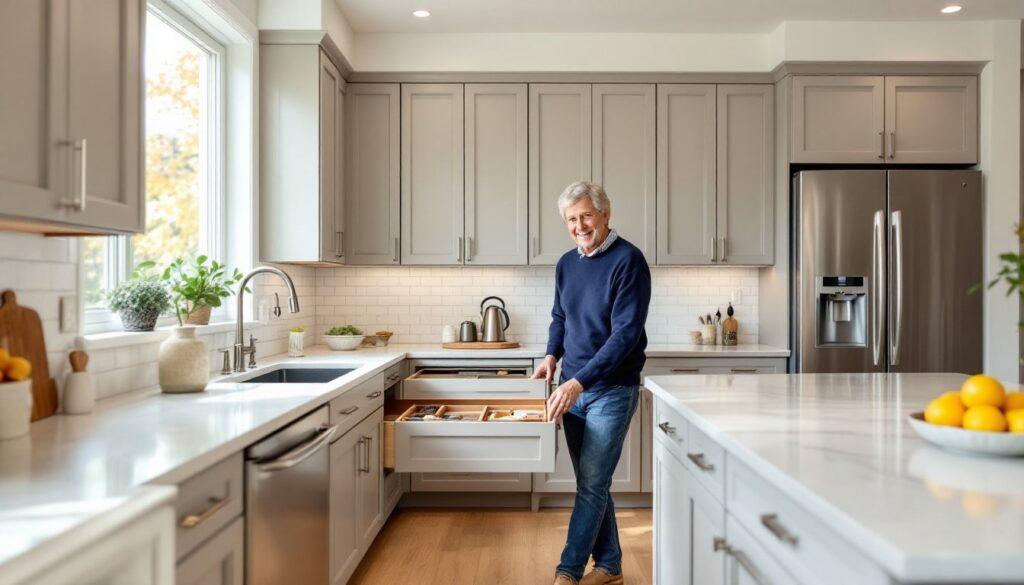
Toe-kick drawers run along the base of kitchen cabinets, utilizing the 3″ to 4″ recess that’s typically wasted. They’re shallow but work well for baking sheets, cutting boards, or flat items.
Overhead storage takes advantage of vertical space. Cabinets can extend all the way to the ceiling, though anything above 7′ requires a step stool. Open shelving near the roofline keeps frequently used items visible without overwhelming sightlines.
Built-in benches with lift-up seats provide hidden storage for bulkier items like bedding, seasonal clothing, or camping gear. Bench depth typically runs 18″ to 20″, which is deep enough for useful storage but shallow enough to maintain walkway clearance.
Many of these small space storage solutions are borrowed from apartment living and adapted for tiny house construction. The key difference: in a tiny house, storage is often built during initial construction rather than added later with freestanding furniture.
Multi-Functional Furniture and Space-Saving Design
Furniture in tiny houses has to earn its keep. Single-purpose pieces are rare: instead, most items fold, slide, or convert to serve multiple roles throughout the day.
Murphy beds (wall beds) are popular in tiny houses without lofts. A queen-size Murphy bed folds up into a cabinet that’s roughly 16″ deep, freeing up floor space during the day. Some models include a fold-down desk or shelving on the exterior face. Installation requires attaching the frame to wall studs, and the mechanism uses gas pistons or springs to counterbalance the mattress weight.
Expandable tables let occupants adjust surface area based on need. Drop-leaf tables, butterfly-leaf designs, and wall-mounted fold-down tables all work. A 24″ x 36″ table might expand to seat four or six people, then collapse to free up walking space.
Storage ottomans and benches provide seating, footrests, and hidden compartments in one piece. Look for units with removable tops or hinged lids for easy access.
Sliding barn doors save the swing clearance needed for traditional hinged doors, typically 30″ to 36″ per door. Barn door hardware mounts on a track above the opening and requires wall backing for secure attachment. Note that barn doors don’t seal as tightly as hinged doors, so they’re less ideal for bathrooms where moisture control matters.
Modular shelving can be reconfigured as needs change. Cube organizers, slotted standards with adjustable brackets, and pegboard systems let owners adapt storage layouts without permanent modifications.
Kitchen and Bathroom Layouts in Tiny Houses
Kitchens and bathrooms in tiny houses must deliver full functionality in dramatically reduced footprints. Compromises are inevitable, but careful planning keeps them livable.
Tiny house kitchens typically range from 4′ to 8′ of linear counter space. Most include a two-burner cooktop or apartment-size range (20″ to 24″ wide), a compact refrigerator (often 10 to 12 cubic feet), and a small sink. Counter depth usually matches standard cabinets at 24″, but some builders go shallower to gain floor space.
Overhead cabinets provide most kitchen storage. Builders often skip upper cabinets on one wall to install open shelving or a window, which helps prevent a tunneled feeling. Dish racks, pot rails, and magnetic knife strips keep daily-use items accessible without cluttering limited counter area.
Bathrooms in tiny houses vary widely. A basic layout might measure 3′ x 6′ and include a corner shower (32″ x 32″), a standard toilet, and a small vanity. More compact designs use composting toilets (which don’t require plumbing) or wet baths (where the entire room is the shower stall). Wet baths save space but require waterproof wall and floor finishes throughout, plus a floor drain.
Ventilation is critical in both spaces. Building codes (IRC) require bathroom exhaust fans, and tiny house builders often add range hoods or additional vents to manage cooking moisture. Without proper airflow, condensation builds up fast in small volumes and can lead to mold.
Proven methods for organizing and decluttering small spaces help keep these compact areas functional, especially when square footage for each zone is minimal.
Sleeping Lofts and Bedroom Configurations
Sleeping lofts are the signature feature of most tiny houses on wheels, reclaiming vertical space for the bedroom and freeing up the main floor for living areas.
Loft dimensions are tight. A typical sleeping loft runs 6′ to 8′ long (enough for a mattress) and 3′ to 4′ tall at the peak. That’s low enough that sitting upright can be awkward, but adequate for sleeping. Width depends on the trailer, but most tiny houses are 8’6″ wide, leaving roughly 7’6″ to 8′ of usable interior width after wall framing and finishes.
Loft access can be a fixed staircase, a ship’s ladder (steeper than standard stairs, typically 60° to 70°), or a simple vertical ladder. Staircases are safer and easier to navigate at night but consume 12 to 20 square feet of floor space. Ladders take up almost nothing but are less practical for kids, older adults, or anyone carrying items up and down.
Main-floor bedrooms are an option in larger tiny houses (300+ square feet) or in designs that sacrifice a dedicated living room. A queen bed requires a footprint of roughly 60″ x 80″, plus clearance on at least two sides for access. Some builders use sliding privacy curtains or panels instead of full walls to separate the bedroom without blocking light or airflow.
Mattress types matter more in lofts. Memory foam and latex mattresses are easier to maneuver up narrow stairs or ladders than traditional innerspring models. Mattress thickness also affects headroom, an 8″ mattress leaves more clearance than a **12″ pillow-top.
Interior Design Styles and Decor Tips for Small Spaces
Interior design in tiny houses balances aesthetics with function. The style choices that work best tend to emphasize light, simplicity, and visual continuity.
Light color palettes help small spaces feel larger. Whites, soft grays, and pale woods reflect light and reduce visual clutter. That doesn’t mean tiny houses have to be sterile, accent walls, colorful textiles, and natural wood tones add warmth without overwhelming the space.
Vertical lines draw the eye upward and make ceilings feel higher. Shiplap or tongue-and-groove paneling installed vertically, tall narrow shelving, and floor-to-ceiling curtains all contribute to this effect.
Minimalist and Scandinavian styles are popular in tiny houses because they prioritize clean lines, functional furniture, and restrained decor. Rustic or farmhouse styles also work well, especially when incorporating reclaimed wood, open shelving, and vintage fixtures.
Mirrors strategically placed across from windows bounce light and create the illusion of depth. A full-length mirror on a closet door or a mirrored backsplash in the kitchen can visually double the perceived space.
Decor restraint is essential. In a conventional home, you might display dozens of books, frames, and knick-knacks. In a tiny house, each decorative item competes for limited surface area. Stick to a few meaningful pieces rather than filling every shelf.
Lighting layers improve both function and ambiance. Combine overhead fixtures (LED can lights or pendants), task lighting (under-cabinet strips in the kitchen, reading lamps in the loft), and accent lighting (rope lights, sconces) to create flexible moods without relying on a single harsh overhead bulb.
Conclusion
Tiny house interiors succeed when design decisions are intentional and every element serves a purpose. Smart storage, multi-functional furniture, and thoughtful layouts transform tight quarters into comfortable, livable homes. Whether building from scratch or renovating an existing tiny house, focus on the details that matter most: structural integrity, adequate ventilation, and storage solutions that fit the way occupants actually live.